- calendar_today August 20, 2025
The research team from Carnegie Mellon University released LegoGPT, which is an advanced AI model that designs stable Lego constructions from text inputs. The system transcends digital modeling by producing Lego constructions that are buildable in real-world settings through both manual assembly and robotic assistance. LegoGPT operates by reading text instructions and generating a Lego brick arrangement sequence to build a stable structure.
According to the team’s research paper hosted on arXiv, they developed a large dataset that includes physically stable Lego constructions together with detailed captions. The researchers trained an autoregressive large language model using this dataset as its foundational training material. The model functions by predicting the next brick in a series while performing “next-brick prediction,” which differs from the traditional “next-word prediction” approach found in standard language models. LegoGPT uses this method to understand instructions such as “a streamlined, elongated vessel” or “a classic-style car with a prominent front grille” and generate matching Lego designs.
Ensuring Stability: A Key Innovation
In 3D design work, the gap between virtual models and their ability to be physically constructed remains a substantial obstacle. Current systems produce complex shapes that frequently fail to maintain the structural integrity needed for real-world construction. The designs include unsupported elements, disconnected parts, and inherent instability that would cause them to collapse immediately. LegoGPT tackles this shortcoming by emphasizing the structural stability of its products during initial creation. Existing autonomous Lego modeling systems fall short in creating buildable structures, but this new system produces Lego models with sequential instructions that maintain structural integrity. The project website showcases demonstrations of LegoGPT’s abilities.
LegoGPT functions through the adaptation of existing technology used in large language models such as ChatGPT. Rather than forecasting the next word in a text sequence, LegoGPT determines the correct position for the following Lego brick. The researchers enhanced LLaMA-3.2-1 B-Instruct, which operates as an instruction-following language model from Meta, to achieve their objective. A dedicated software tool expanded the core model’s capabilities by enabling verification of design stability through mathematical models that simulate structural forces and gravitational effects.
The Fine-tuning of LegoGPT utilized the “StableText2Lego” dataset, which includes more than 47,000 stable Lego structures paired with OpenAI GPT-4o-generated descriptive captions. Researchers conducted extensive physics analysis for every structure in this dataset to ensure it could be built in the real world. LegoGPT operates by producing an exact series of brick placements that ensures each newly added brick avoids collisions while remaining inside the designated construction area. The finalized design undergoes evaluation by integrated mathematical models to determine its stability against collapse.
Validating Real-World Construction
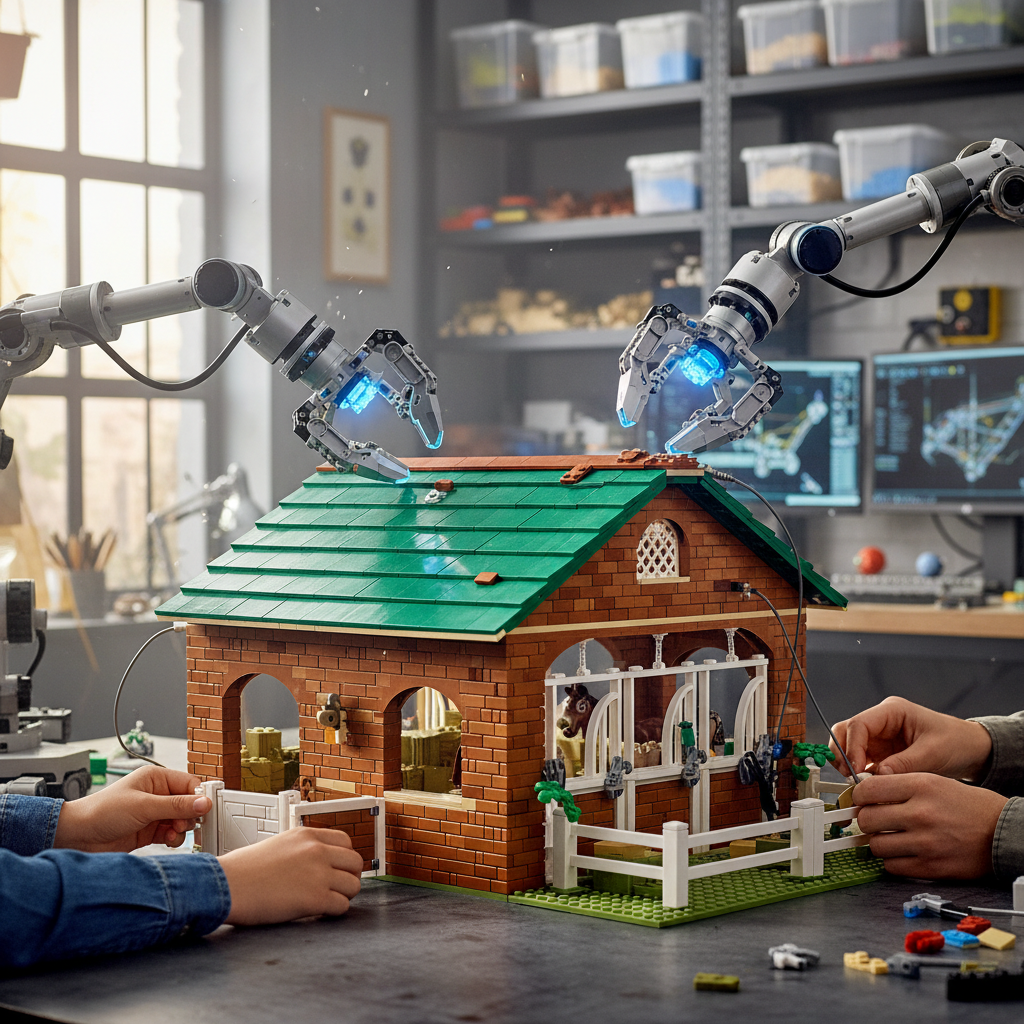
Research required practical validation of the AI-designed models by constructing them in real-world environments. The study team used a dual-robot arm system with force sensors to precisely position bricks following LegoGPT instructions. Human testers built some of the AI-constructed models by hand which verified that LegoGPT generates structures that can be assembled physically. According to the research team’s paper their experiments showed that LegoGPT can create stable and visually pleasing Lego designs that accurately reflect the original text prompts while maintaining variety.
LegoGPT stands out from other AI systems geared toward 3D creation like LLaMA-Mesh because it focuses primarily on structural integrity. According to the team’s evaluations, their approach produced the greatest percentage of stable structures. The researchers admit that LegoGPT presently functions within a 20×20×20 building space while working with only eight basic brick types. Upcoming research plans to broaden the brick library with additional dimensions and brick types like slopes and tiles to boost system functionality. The development of LegoGPT shows how AI can connect digital design with real-world building processes through its groundbreaking capabilities.