- calendar_today August 6, 2025
Why Assassin’s Creed’s Themes Still Resonate Today
Netflix has greenlit a live-action Assassin’s Creed series that’s been in development for some time now.
The video game series, developed and published by Ubisoft, began back in 2007 with an original release of the same name. After several releases on console and mobile, it’s finally set to leap to the small screen in live-action form.
The streaming service has confirmed the series is still on track and now has two showrunners onboard. Netflix has appointed Roberto Patino and David Wiener to co-run the show. Patino has written for various series for HBO and FX, while Wiener has led work on AMC’s Fear the Walking Dead and Paramount+ adaptation of Halo.
Netflix also released a statement from the showrunners about the series that’s still in the early stages of development.
“We’ve been fans of Assassin’s Creed since it was released in 2007. Every day we work on this show, we come away excited and humbled by the possibilities that Assassin’s Creed opens to us,” Patino and Wiener said. “Beneath the scope, the spectacle, the parkour and the thrills is a baseline for the most essential kind of human story—about people searching for purpose, struggling with questions of identity and destiny and faith. It is about power and violence and sex and greed and vengeance. But more than anything, this is a show about the value of human connection, transcending cultures and time. And it’s about what we stand to lose as a species when those connections break.”
The showrunners went on to promise fans a “big TV show” and that Netflix and Ubisoft have been great partners in developing the series. The showrunners then finished the statement by saying their production team is “amazing” and that fans across the world can expect something “undeniable.”
A Franchise with a Lot of History
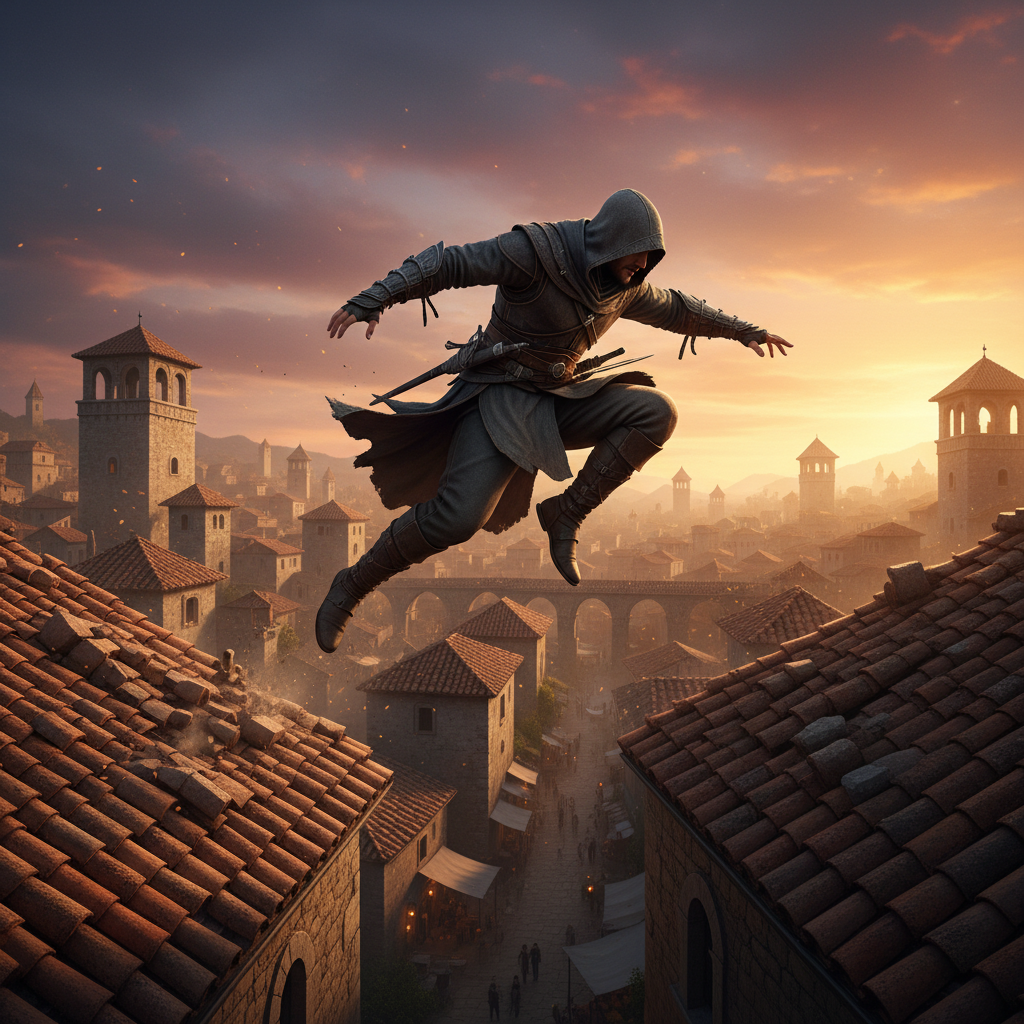
Assassin’s Creed was first a “social stealth” action video game franchise released in 2007. It was a hit, and the series became a major name in the video game space. The first game takes place during the time of the Crusades and follows an Assassin named Altair.
The game didn’t stick around in the period and instead used Renaissance Italy as the stage for the next three games. This new trilogy is what made the franchise shine. Assassin’s Creed II, Brotherhood, and Revelations introduced the character Ezio Auditore and featured a balance of historical intrigue, philosophical debate, and some cool fight choreography.
In the 18 years since the franchise’s initial release, 14 Assassin’s Creed games have come out, and the series has morphed from a stealth action game to an open-world RPG. The stories have taken players to several different times and places across the world. It’s become a go-to for major historical events in the franchise, like the American Revolution, the Golden Age of Piracy in the Caribbean, Revolutionary Paris, Victorian London, Ancient Egypt, Classical Greece, Viking Britain, and more recently Baghdad during the Islamic Golden Age.
Ubisoft released Assassin’s Creed: Shadows last year, which places the franchise in feudal Japan. It was generally well received and credited for being a large refinement to the RPG style that the more recent games have used, while still maintaining the essence of what players love in the franchise. One large reason for its success is that Ubisoft delayed the game’s launch by almost two years to improve its quality and level. It’s a tactic fans are hoping will happen with the live-action series as well.
How We Know About the Series (Currently)
Details about the upcoming Assassin’s Creed series have been slim to none, but there are certain elements we can expect from the games to make the jump to the small screen. A core aspect of all Assassin’s Creed games so far is a large-scale secret war between the Assassins and Templars. These are two rival factions, often thousands of years old, that battle over the future of mankind.
The bridge for all these stories is the Animus, a device which modern-day Assassins can use to live out the genetic memories of their ancestors. This then places them in important historical moments across the globe.
There’s no information on casting, and while it’s unlikely it will follow the story of an already existing character, fans are asking the question anyway. Since the 2016 film starring Michael Fassbender went on a different story path, this series will likely do the same.
The film received mixed reviews from audiences and critics, and while it was a modest success, it’s unknown if the series will acknowledge it or not. The big thing for Assassin’s Creed is that with more live-action high-budget and lore-heavy properties on streaming services more than ever, and a constant interest in video game adaptations, it seems like a good time to try again for a good adaptation.
Netflix is doubling down on Assassin’s Creed, which is just one major video game franchise in a sea of others, to make it big time on screen. Game-to-screen adaptations have a rocky history, but they’re becoming more respected and popular. HBO recently set a new standard for what these adaptations can be with The Last of Us.
Netflix has also found success with video game-based series in The Witcher, but has also had a few struggles on that front as well. Assassin’s Creed has a good shot of being a hit series, too. But does it have the potential to be critically successful as well?
Whether Netflix can hit the critical high mark like HBO did is to be seen. But, with showrunners that have the knowledge and experience of how to make a video game-based series work in the current market, an extremely popular global brand, and a near-limitless amount of history to explore in their sandbox, it seems there’s the potential here.
Right now, fans will just have to be patient and wait for more details to come out as casting, filming, and further creative development all happen. If Netflix and Ubisoft manage to make it work, then Assassin’s Creed could be one of the next big fantasy-historical spectacles of the streaming era.