- calendar_today August 14, 2025
.
The future of electric vehicles is clouded by a growing chorus of doubt. After the industry experienced 14 consecutive months of year-over-year sales growth through April, that trend has reversed with sales now contracting. Buyers have turned away from EVs made by Genesis and Volvo, spurring the two carmakers to adjust their product strategies.
Adding to the confusion is a flurry of policy changes by the Biden administration. The White House has reinstated fuel efficiency and vehicle pollution standards that were relaxed by the Trump administration. Meanwhile, it has reduced subsidies to buyers and automakers, offering less in federal tax credits than under past policies. However, according to Telemetry, the biggest factor in the U.S. may not be policy at all.
The Garage as EV Bottleneck
Electric vehicle surveys have long pointed to a common concern among consumers: charging. The largest threat to EV adoption is the anxiety about where and how drivers will recharge. A new report from Sam Abuelsamid, vice president of Telemetry, attempts to unpack one underappreciated reason for these worries: the state of the American garage.
Highway chargers have garnered a lot of attention in recent months as the public charging infrastructure experiences hiccups. But the vast majority of EV charging is done at home, and much of that is powered by AC energy. AC charging accounts for roughly 80 percent of all EV charging, the majority of which happens at a single-family dwelling.
A report by the National Renewable Energy Laboratory (NREL) looked at EV adoption in the country’s 119 million homes, finding that almost 42 percent of homeowners already have an outlet within reach of an EV parked in a garage or driveway that is capable of supporting level 2 (240-volt) charging. By Abuelsamid’s reckoning, this could rise to 68 percent if more people parked in their garages and cleared out space.
The Telemetry executive notes that “90 percent of all houses can add a 240 V outlet near where cars could be parked. Parking behavior, namely whether homeowners use a private garage for parking or storage, will likely become a key factor in EV adoption.”
Parking Space Limitations
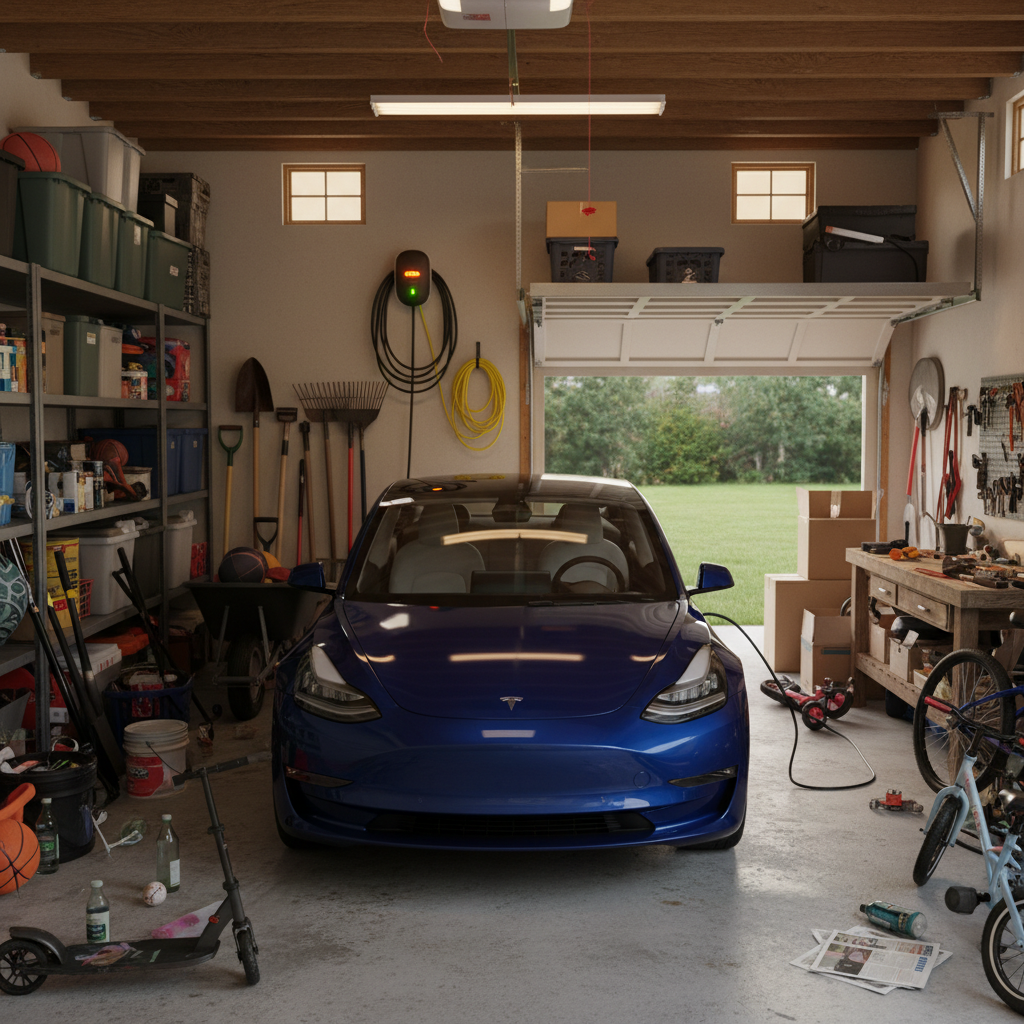
Unlocking that potential will require action by drivers themselves. The garage is often cluttered with spare appliances, DIY supplies, and just general clutter. Simply clearing out space could raise the number of homes capable of EV charging from 31 million to more than 50 million, according to Telemetry. Add in homes where additional wiring is possible and that number climbs to more than 72 million. That’s higher than even Telemetry’s best-case scenario for EV penetration in 2035 (33 million to 57 million vehicles).
That doesn’t mean that EV charging would be an option for every driver, however. The NREL study noted that almost 34 million U.S. homes would need electrical upgrades to run a level 2 charger. That can require expensive new wiring and a whole new panel in many cases, with costs easily in the thousands of dollars. The cost could quickly eat away at a key advantage that EVs have over traditional gas-powered vehicles: long-term affordability.
Apartment Parking Problems
Drivers in multifamily housing, meanwhile, have their own set of challenges. Apartments, condos, and townhomes account for 23 percent of U.S. homes. In these dwellings, individual owners rarely have the authority to install chargers. Instead, they must appeal to their landlords, property management company, or even co-op board. Getting permission can be difficult and time-consuming.
The financial hurdle is also higher in multifamily properties. Even adding a pair of shared level 2 chargers in a co-op may require a full electrical panel upgrade, a job that can cost millions of dollars. Wiring chargers far from the building, where many parking spaces are, is even more expensive. Many of these residents are also not eligible for municipal or utility subsidies to defray the cost, unlike many homeowners.
With 1 million EV owners living in multifamily housing today, these issues are already a major roadblock for the industry. As of now, only 11 percent of them are able to park close enough to an outlet to charge. Telemetry projects that up to 6.7 million to 11.4 million charging-capable spaces will be available in these buildings by 2035. That includes spaces in developments built after states began requiring that 20–25 percent of spaces be EV-ready.
Public Charger Demand to Grow
As these numbers suggest, the role of public charging will become increasingly important. The Telemetry forecast estimates that as many as 11.7 million to 14.3 million EV drivers who own single-family homes will rely on public charging by 2035. Another 7.8 million to 8.1 million EV drivers who live in multifamily residences will also be dependent on public charging stations.
The demand for public charging sites could be high in the coming decade. Telemetry forecasts that the U.S. could need between 523,000 and 586,000 DC fast chargers, as well as an additional 1.5 million to 1.6 million level 2 chargers in total by 2035. The challenges for building that network include a strained electric grid. Power companies are under pressure as new AI data centers compete for the same generation and distribution resources, making the building of large public charging sites more difficult.
Slowdowns Ahead?
While Tesla and other automakers continue to be bullish on EVs in the U.S., the reality is likely to be more complicated. Although many U.S. homes have the potential to support EVs, a host of factors including garage clutter, prohibitive electrical upgrade costs, and the constraints of multifamily living could limit adoption. Even with a strong rollout of public chargers, the number of charging-capable homes may not keep up with demand.
As it stands, the path of EV adoption in the U.S. is looking less clear-cut than expected. The bottleneck may be found in many Americans’ garages rather than any federal policy or automaker strategy.