- calendar_today August 31, 2025
Alien: Earth Explores the Rise of Hybrids in the Corporate Era
FX and Hulu’s Alien: Earth is closing in on a 2025 premiere date. The prequel series to Ridley Scott’s Alien has built anticipation over the past year with production updates, a character poster, a teaser trailer, and now a first full trailer. In July, it was also announced that series creator Noah Hawley and his FX and Hulu team would provide one last trailer for Alien: Earth and a fuller synopsis before the August 12 premiere.
This final trailer hints at both the cerebral and the horrifying aspects of the show, mixing slow, introspective (almost existential) moments with pulpy sci-fi/horror: alien craft drifting weightlessly in zero gravity; floating corpses scattered on dark corridors; human figures running, their faces covered in blood, as they flee an indistinct threat; and, above, a silhouetted wing-span hinting at the franchise’s most famous predator: a xenomorph crouching in the shadows.
Hawley has been clear that Alien: Earth will be a colder, more clinical series than its prequel predecessors, leaning heavily into both the industrial tone and the human/alien mythology established by the original Alien in 1979, rather than 2012’s Prometheus and 2017’s Alien: Covenant. Set in the year 2120, two years before the events of the first film, Alien: Earth imagines a near-future Earth driven by corporate-military power brokers grasping to exert control over human civilization’s greatest resource, and arguably its most dangerous: life itself, and the possibility of immortality.
Corporate Hegemony in the Year 2120 and the Birth of the Hybrids
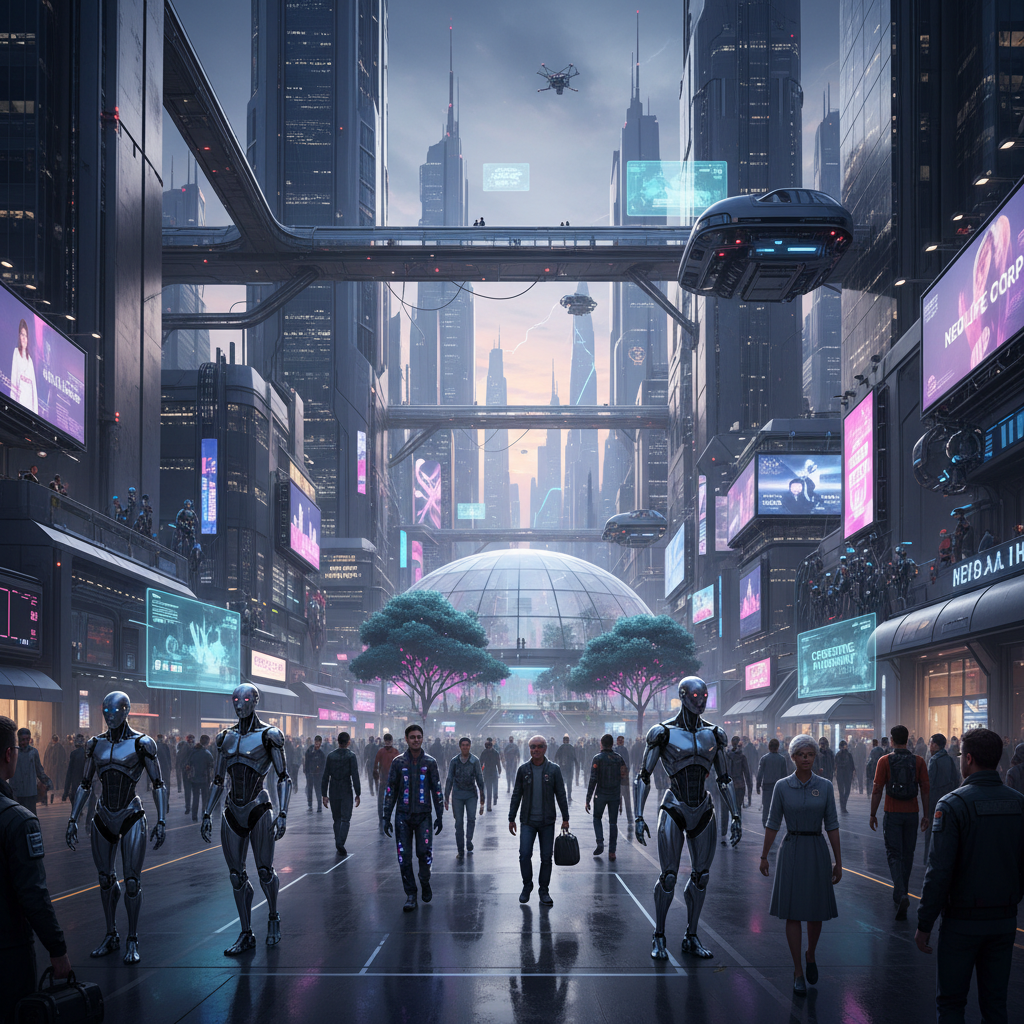
Alien: Earth’s future takes place in the year 2120, a time when Earth’s governments have given way to corporate oligarchies. Five mega-corporations hold power over Earth and Beyond: Prodigy, Weyland-Yutani, Lynch, Dynamic, and Threshold. It is the Corporate Era, a time when technology has changed life on Earth beyond all recognition. Cyborgs, human beings whose bodies have been modified with artificial parts, walk the streets beside synthetics, humanoid robots whose actions are powered by advanced artificial intelligence.
Prodigy Corporation, one of the biggest in the world, has changed this landscape once again by developing a radical new iteration of synthetic, a humanoid robot that is embedded with actual human consciousness. The world’s first is Wendy, a twelve-year-old hybrid, played by Sydney Chandler. “The body of an adult, with the consciousness of a child,” Wendy is an experiment in the mad quest for immortality.
Prodigy CEO Kirsh (Timothy Olyphant), a synthetic himself, has had Wendy built in the likeness of his lost wife, casting her as the literal girl Friday to his virtual office. She is, perhaps, just a research asset for Prodigy and the other megacorporations that seek eternal life, but an asset who will change the course of human civilization.
Alien: Earth trailer “reveals” the events set in motion when the Weyland-Yutani Corporation spaceship crashes on Prodigy City. Wendy and a group of other hybrids are sent to investigate and unwittingly become exposed to a new, deadly, unknown alien organism, creatures that, in true Alien franchise fashion, are brought back into the lab to be studied.
Joining Chandler as the lead in Alien: Earth are Timothy Olyphant as Kirsh, Wendy’s synthetic mentor and trainer; Alex Lawther as soldier CJ; Samuel Blenkin as Boy Kavalier, a young and calculating CEO; Essie Davis as Dame Silvia; Adarsh Gourav as Slightly; Kit Young as Tootles; David Rysdahl as Arthur; Babou Ceesay as Morrow; Jonathan Ajayi as Smee; Erana James as Curly; Lily Newmark as Nibs; Diem Camille as Siberian; and Adrian Edmondson as Atom Eins.
From Teaser to Trailer: The Story is Revealed
FX and Hulu were clever with their teaser for Alien: Earth, revealing that short one in January. Staged as an intermission in a live NFL game, the trailer was an unexpected eight-second shot entirely from the point of view of the franchise’s iconic xenomorph. We see the alien on a spaceship corridor, moving with speed and lethal grace toward the camera (i.e., the viewer). The spaceship itself was hurtling directly towards Earth on a one-way trajectory. There was no context for the viewer, but the simple effect was electrifying: a spin on true horror cinema that was as scary as it was clever.
For some context, FX and Hulu’s first full trailer for Alien: Earth arrived last month, after the NFL teaser. It opened with scenes from the early days of Wendy’s creation in the year 2120 on Neverland Research Island. When the alien spaceship crashed near Earth, Wendy bravely volunteered to help retrieve its mysterious cargo. She discovered an experiment in death, and in grisly detail. The craft’s airlock opened up to five alien life forms: dead, unknown, lethal species that are, of course, per the Alien franchise playbook, brought back into a laboratory setting.
It’s a set-up that audiences will find familiar if they’ve read into the early iterations of the franchise’s mythology, in which so much corporate and human overconfidence meets a perfect apex predator. It’s also the familiar formula for Ridley Scott’s horror classic that made an audience of all ages (and ages to come) both think and shudder in turn. The newest final trailer for Alien: Earth reiterates the series’ likely more cerebral tone and aesthetic. Alien: Earth will expand on its overconfident world of corporate capitalism and human engineering, where everything is under control. Instead, we will see that nothing is. Hawley’s and FX/Hulu’s world will (in turn) fall apart.